

🔬 Measure the unseen, master the UV scene!
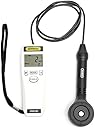
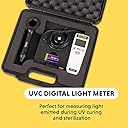
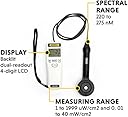
The General Tools UV512C Digital Ultraviolet UVC Light Meter delivers precise UV measurement within the 220-275 nm range, ideal for lab, industrial, and environmental monitoring. Featuring a broad measuring range (1 μW/cm² to 40 mW/cm²), fast sampling, and a backlit dual LCD, it supports up to 20 stored readings with automatic interval recording. Lightweight and portable, it includes tripod and magnetic mounts for flexible use, making it an essential tool for professionals demanding accuracy and reliability in UV radiometry.


| ASIN | B002XZLTRS |
| Batteries Included? | Yes |
| Batteries Required? | Yes |
| Battery Cell Type | Alkaline |
| Best Sellers Rank | #338,015 in Industrial & Scientific ( See Top 100 in Industrial & Scientific ) #144 in Lab Photometers & Light Meters |
| Certification | No |
| Customer Reviews | 4.2 4.2 out of 5 stars (128) |
| Date First Available | December 13, 2006 |
| Included Components | One UV probe, tripod screw, magnetic mount, hard foam-lined carrying case, and one 9 V battery |
| Is Discontinued By Manufacturer | No |
| Item Package Quantity | 1 |
| Item Weight | 0.8 ounces |
| Item model number | UV512C |
| Manufacturer | General Tools |
| Part Number | UV512C |
| Power Source | Battery Powered |
| Product Dimensions | 2.88 x 10.63 x 10.5 inches |
| Size | 220-275nm |
| Style | 220-275 nm |
| Warranty Description | Warranted for workmanship and materials |
A**R
Great price on an accurate meter for UVA
I had cataracts and got a lens called LAL+. These are adjustable after you get LAL lenses put in. The problem is that they make you wear UV400 certified glasses until you get the vision updates locked in. This meter is perfect for measuring your glasses and for measuring your environment. The UV frequency you have to avoid with the LAL lenses is between 200 and 400 NM. Specifically 165NM. This meter makes life easy. Great price. With this meter you can buy any UV400 certified pair of glasses and make sure they meet spec.
A**Y
Well-bult digital UV meter
I like this digital UV meter because it lets me know how strong UV light will be from many sources. For example, somebody says the halogen light at your desk has very strong UV. After I bought this meter, I measured UV light from halogen bulb, CFL bulb, LED light bulb, incandescent light bulb at home and know exactly how much UV light emitted from them with compared to the UV light from the Sun. In this way, I can avoid the source that emits very strong UV light. This meter was built very well. It comes with a hard case although the hard case was not shown in the picture. The wand in this meter need a simple assembly by using five supplied screws but it is very easy. The measurement is very sensitive and the sampling rate seems high because I can see the measured value changes very quickly. It totally met my expectations so I give 5 stars.
L**O
Excellent product and good price.
This item works very well and accurately.
P**E
Modestly Priced UVA Meter with a Few Limitations
Needing to test various UV light sources, I purchased the General Tool UV513AB Digital UVAB Meter to provide a greater level of accuracy and precision than a personal UV meter intended for consumers. While I have generally been content with this instrument, the name of the meter is a bit of a misnomer as it is truly a UVA meter calibrated for 365nm, which is well outside the UVB range. Sensitivity drops off significantly in a somewhat asymmetric distribution about 365nm, reaching zero % sensitivity at 280nm and 420nm. An important UVB wavelength - 308 nm - has a spectral sensitivity of only 30%. There is no setting, adjustment or filter to obtain a better measurement of UVB wavelengths. It is some difficult to objectively review and rate such a device because its well and not-so-well understood limitations can be attributed to its modest price. Other laboratory grade UV meters can cost more than three times as much and beyond. So, it is the value and utility that must be discussed. Compared to a personal UV meter such as the Oregon Scientific EB612 Personal UV Monitor, this instrument is quite a powerful tool that is easily worth five times as much. The General Tool UV513AB allows for real time UV measurements in a value that can be interpreted on an absolute scale in universal metrics of mw/cm^2 - not an ambiguous continuum meaningful only to the instrument such as relative intensity of 1 - 20. This is especially helpful when observing the output of UV LEDs whose output can vary based on temperature. There are some deficits that are inexcusable, even at its low price point. Despite being a relatively simple device, the menu navigation is oddly confusing. The manufacturer should have added an additional button or switch to avoid the need to cycle through different functions. It is nice, however, that there are two readouts, including one that is able to show min, max, and average values. The meter also has a data store capability that can be displayed on the secondary reading while the main function is still being displayed. The manual for this meter is poorly written. One of my big concerns is that at least one of the specifications is incorrect. The "High Illumination" spectral range is listed at 0.01 mw/cm^2 to 40.00 mw/cm^2. Yet, I have exceeded 40 mw/cm^2 numerous times, reaching up to 66 mw/cm^2. Given that an almost identical meter is sold by Sper Scientific, my guess is that General Instrument didn't make or design this product. Hence, the manual was probably written by someone else other than the designer or manufacturer. Regarding the fundamental capabilities of the sensor, the 40 mw/cm^2 maximum value is well below the output of many light sources, including UV lasers and high brightness LED modules. Just for reference, readings of greater than 8.5 mw/cm^2 can be reached at the sun's maximum intensity during the day in the Midwestern United States. Like the wavelength sensitivity limitation, the maximum intensity ceiling could be addressed with different filters, which can often be extremely expensive. It would be helpful if General Tool could provide easily attachable and modestly priced filters including bandpass variants to address the wavelength and max intensity issues. Despite all of the limitations, this instrument is a good value - especially when compared to what is offered in the larger scientific instrument market. For example, a small bandpass UV filter used to obtain a better reading on a specific UVB wavelength could cost several hundred dollars from a supplier such as Edmunds Scientific. I would have appreciated a few additional capabilities but the price would be expected to increase dramatically. That being said, this instrument is a solid four stars compared to what is available at both lower and higher price points. Pros Inexpensive Flexible sensor mounting/use with wand High level of precision in the microwatts and reported accuracy of 4% Portable Easy to understanding readings Min, max, average readings with data store Cons Poorly written manual Complex function navigation
R**D
Works Great for Measuring Relative Sun UV Intensity!
A great tool for those with sun photosensitivity. The absolute numbers on the scale mean little to me, but that is no problem; comparing direct light levels at high noon vs. afternoon vs. first light, through a car windshield and a car side window, through home windows, etc. to know how much relative UV is in each situation is very helpful!
A**R
VERY DECEPTIVE ITEM DESCRIPTION; BE CAREFUL!
General Tools UV513AB Digital UVC Meter, 280-400 nm [THIS IS COPIED FROM THE ITEM DESCRIPTION] I will return this item since the description of the item (copied and pasted above from the Amazon.com website today April 25, 2018 (also see a photo of the website description) does not match the item I received (see photos of item description on the packaging of the device received). There is a deceptive variance! As a novice to measuring UVA, UVB, and UVC, I read the description of the item on Amazon.com as a “UVC Meter.“ Perhaps others might fall for this description as I did. Most of us, I think, would believe that if something says it is a “UVC Meter” then that it means it is a UVC Meter. The item received is only for UVA and UVB measurements. VERY DECEPTIVE. How a seller can say that the item I received is a “UVC Meter“ is beyond comprehension and inexcusable! It seems like the description could be perceived as fraud, no? In case another person is interested, Wikipedia says that UVA spans the wavelength of 315-400 nm. UVB spans the wavelength of 280-325 nm. This item, therefore will measure both UVA and UVB from 280 to 400 nm. I take it from other reviews that separation of UVA measurements from UVB measurements may not be possible. Check on that if it is important. According to Wikipedia, UVC is measured at 100-280 nm, clearly well outside the capabilities of this item as described in its packaging.
N**A
It has more than paid for itself
This tester has saved me many hundreds of dollars in UV bulbs. It's recommended to change reptile bulbs every 6 months. This meter tells me exactly how much UV my bulbs are making. Most (not all) Zoo med bulbs, in particular, continue to produce acceptable amounts after more than a year of 12-hour days. My reptiles and my wallet are happy. Thank you!
J**N
great, sturdy, product for measuring sun protection.
Great product, well built. It has two "scales" so microwatts/cmsq and milliwatts/cm can be used depending on the intensity of light. Full summer sun in the 12 milliwatt range, while indoor, through curtains, clothing, etc. in 100's of microwatts. One can get a great "feel" for the difference in intensity using the two scales. If one keeps in mind that it's uvb sensitivity is only 20-30% of its uva sensitivity, one can still use it to compare the protection various materials provide for sun exposure, just by comparing the *relative* intensity of measurments with/without protection. It cannot "switch" between measuring uva, then uvb separately, event though the manual suggests it might be possible.
Trustpilot
1 day ago
1 month ago